Yes — you can hunt
deer with an air rifle
in Texas.
There is a specific, published standard the rifle has to meet, and it is the fastest way to explain what a modern PCP airgun actually is. Everything on this page comes from the Texas Parks & Wildlife Department's own Outdoor Annual.
Deer, bighorn sheep,
javelina, pronghorn
For these species Texas requires pre-charged pneumatic equipment specifically — not a spring or break-barrel airgun — and it has to meet all of the following.
The velocity and energy requirements are an either/or: 800 fps, or any combination of bullet weight and muzzle velocity that produces at least 215 ft-lbs.
Alligator, bighorn sheep, javelina, mule deer, white-tailed deer, pronghorn, and turkey (except wild turkeys in the East Zone).
Squirrel, pheasant,
quail, chachalaca
Lesser-powered air guns are permitted for upland birds and small game, with a much lower floor.
Alligator, game animals, furbearers, squirrels, and non-migratory game birds, except wild turkeys in the East Zone.
Arrow-gun projectiles must meet the same standards as archery projectiles, and arrow guns may not be used to hunt deer or wild turkey during archery season.
What TPWD adds
TPWD's own page on air guns adds guidance for hunters to reduce wounding loss. In short:
75 yards or closer
TPWD recommends an effective range of 75 yards or closer. Big game has been taken past 150 yards, but TPWD says some models lose lethality beyond 75.
Know your shots per fill
The air charge drops with every shot. TPWD says to know how many shots a fully charged tank gives before the gun loses its effectiveness.
Wait an hour
As with archery, TPWD advises waiting an hour before going to retrieve a deer or other game animal, so it has time to expire.
Check specs before you buy
TPWD advises checking the specifications before buying an air gun, to be sure it meets the minimum caliber and velocity or energy requirements.
This season
The main 2026–27 dates, as TPWD prints them.
Archery only means bows and crossbows, and youth only means licensed hunters 16 and under. TPWD says 252 of 254 counties have a season, and it sets bag limits by county, so confirm before you hunt.
Figures above are from the Texas Parks & Wildlife Department Outdoor Annual and are provided for reference. Regulations change — confirm current rules with TPWD before you hunt, and check your city and county ordinances on discharge. We are glad to talk it through, but we cannot give legal advice.
Why the .30 floor
changes the shopping list.
The legal minimum is also a practical dividing line. Below .30 you are buying a pest-control and small-game rifle. At .30 and above you are buying a big-game rifle, and everything downstream changes with it.
Air consumption
Big bore calibers use far more air per shot, so you get fewer shots per fill. That pushes most big-game shooters toward a carbon-fiber tank rather than relying on a compressor alone.
Projectile choice
At .30 and up you are shooting slugs, not pellets, and the specific slug your barrel likes has to be found by testing. We carry big bore slugs to .458 and .510.
Range discipline
More energy does not mean a flatter trajectory. Airgun arcs are steep, so knowing your actual holdover at your actual distance matters more than it does with a centerfire rifle.
Big bore, .30 and up
These are the platforms in our catalog built for big game. Whether a specific rifle and projectile combination meets the standard depends on the load — which is exactly the kind of thing worth asking us before you buy.
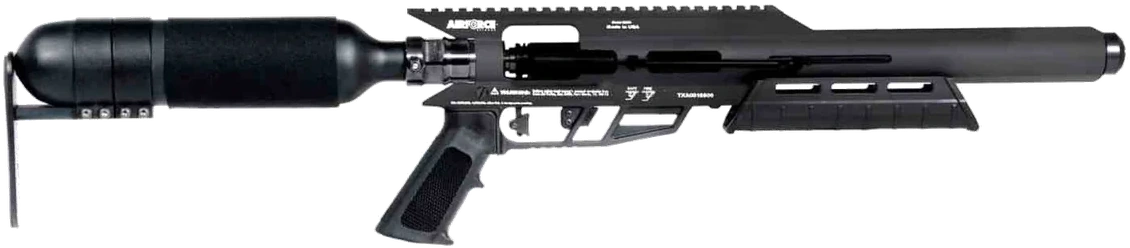

We have deliberately not published velocity or energy figures for individual rifles on this page. Those numbers depend on the projectile, the fill pressure and the tune, and quoting a manufacturer's best case would be a bad way to make a legal decision. TPWD itself says to check the specifications before you buy. Bring us the setup and we will talk through what it actually does.